
TenantSee Weekly
2026 Archives
It’s Not What We Do (For Work). It’s How We Do It
To be sure, life circumstances play a significant role in shaping the work we do and the opportunities available to us. I don’t mean to be tone-deaf or to ignore the fact that many people around the world lack the luxury of reflecting on their relationship with work. But for many of us, whether our collars are blue or white, there is an opportunity to consider not just what we do, but how we do it.
I’ve spent my entire career in the office leasing business. The circumstances have varied, but the fundamental work has remained much the same. What’s been interesting to me lately is realizing just how much I’ve come to appreciate certain aspects of my work.
Of course, I don’t love every facet of it. But over the years, I’ve found ways to lean more heavily into the parts I genuinely enjoy, which also happen to be the things I do best. Yes, I still need to show up for the less enjoyable parts. But their impact on my overall happiness has diminished because I’ve learned to appreciate the opportunity to do my work well, in ways that are uniquely my own.
And I think that’s where the magic lies.
It’s not simply about becoming better at what we do. It’s about discovering our own individual ways of doing it better.
In my case, it took many years to develop the confidence to conduct my business in a way that feels authentically mine. I suspect this is true for others as well. Early in our careers, we tend to look outward for examples of how things should be done. We learn from others, adopt their methods, and measure ourselves against their standards. There’s value in that, of course. But eventually, perhaps, the greater opportunity is to look inward.
To recognize that the ways in which we see things differently, approach problems differently, and bring our own sensibilities to our craft aren't shortcomings to overcome. They may be our greatest strengths.
And perhaps it is in discovering and honoring those differences that we find not only greater success in our work, but greater joy in doing it.
This has certainly been true for me.
Why is Startup Leasing so Funky?
Too many startups employ a broken process in securing office space. I began to wonder, is it because many of the junior brokers who “advise” startups define their value by the spaces they show, not by the process they run? Or does AI have a hand in shaping how these tenants engage the market? I already know about the broker issue, so I decided to put AI to the test to see how it may be influencing startup behavior.
I gave Claude the following prompt: “I have been asked by our founders to secure a new office lease for our company. We are 50 people now. We work in the office 5 days a week. We just secured Series B funding in the amount of $300M. We plan to hire 50 more people in the next 6 months. I’ve been asked to find 20,000 SF of space in a building that provides future growth in downtown San Francisco. We need the space immediately. How should I approach this project to ensure success?”
The response got some things right and others wrong.
The most useful element was the framing: “Treat this as a speed and flexibility problem, not a rent problem. At this stage, the cost of being wrong on space (stalled hiring, a forced second move) dwarfs any rent savings.”
On sequencing, Claude correctly made “locking the requirements” step one. We talk about this a lot. Search is hard when you don’t know what you’re looking for.
The very next step Claude recommended was to hire a tenant advisor. That is sound advice, but the model repeated a common misconception: that a tenant representative is “free” because the landlord pays the commission. Landlords generally do pay it, but it is built into the financial structure of the lease, which means the tenant pays for it through rent.
Claude also recommended bringing on an architect and/or project manager to help evaluate space. Both are valuable.
I then shared with Claude my plan to work with several brokers at once, as that seemed the fastest way to see every relevant space and be sure I wasn’t missing something. Claude flagged the approach as problematic and cited several good reason why.
However, in arguing for one broker, Claude seemed to reinforce the notion that a broker is only as good as the space he shows. There was no talk of selecting the broker with the best strategy and track record, for example.
My sense is that startups typically begin thinking about space, not advisors. Then, they meet brokers who pitch space, not process. And when they turn to AI for answers, it reinforces the idea that a good broker is the one who knows where all the space is being hidden.
Thoughts on AI Conference San Francisco 2026
Our work is helping office tenants negotiate better office leases. So why would we spend two days at an AI conference?
Because we use AI every day. It has become an increasingly important resource in our business, streamlining workflows, accelerating research and analysis, and improving the way we present our findings to clients. Also, over 50% of the current demand for office space in San Franscisco is comprised of AI companies - - - they are the key engine driving this market.
We attended the first AI Conference in 2023. It was a relatively small affair. This year, roughly 5,500 people attended, with about 75 companies presenting products and services. The growth of the conference itself says something about how quickly this industry is developing.
It should come as no surprise that one of the largest groups of companies was focused on AI testing, security, governance and evaluation. There was considerable discussion about jailbreaks involving OpenAI and Anthropic models, along with the broader challenge of monitoring and controlling increasingly agentic behavior.
Another major category was infrastructure and productivity.
Compute is massively expensive. A growing number of companies are building tools that measure AI productivity, track usage and spending, and determine which models are best suited to particular tasks. Others are focused on optimizing inference, the process that takes place when a trained model is actually called upon to perform a task. As AI use scales across organizations, managing the cost and efficiency of all this activity is becoming an industry of its own.
There was a smaller contingent of cloud and hardware companies, including GPUs, servers and related infrastructure, and a handful of robotics companies. The dancing robots, predictably, were a big hit.
One thing that stood out was how many companies had raised substantial amounts of capital while maintaining relatively small teams. That makes sense when you consider the nature of many of these products, which are highly technical, highly scalable and, once built, not necessarily people intensive.
Most of us have probably yet to fully grasp the implications of agentic AI.
We still tend to think of large language models as search engines on steroids, systems that answer questions, summarize information and generate content. But the next generation of use cases goes much deeper. These systems will increasingly be given goals and the ability to execute multiple steps on our behalf.
Over the next five years, for example, e-commerce may be substantially rebuilt around AI agents that research products, compare alternatives, negotiate transactions and make purchases on behalf of humans. Similar changes are likely across finance, healthcare, professional services and countless other industries.
Some argue that forms of AGI have effectively already arrived. However one defines it, the gains in model capability over the past five years have been extraordinary. The harder question is what happens if, or when, models become capable of substantially improving the systems that come after them, without human intervention.
Lately, I’ve been reading Karen Hao’s Empire of AI, a decidedly more pessimistic examination of the AI industry. It is a useful counterweight to the optimism surrounding much of the technology.
AI is an extraordinarily powerful and increasingly polarizing force. Whatever one thinks of it, the technology appears likely to reconstitute significant aspects of how society and the economy function.
And slowing or stopping its development seems unlikely, absent some truly catastrophic event at scale. Even then, the technology may already be too widely distributed to put back in the box.
Which leaves us with perhaps the most important challenge of all: building increasingly powerful AI systems in ways that keep their objectives aligned with those of humankind.
Why Ready-to-Go Offices Cost 25% More
San Francisco’s office market has long moved to the rhythm of tech demand. Today, a growing share of tenants wants space immediately, and landlords are racing to deliver offices that are ready to occupy.
When tech demand has accelerated in past cycles, move-in-ready space has commanded a premium. During the dot-com boom, some companies leased twice the space they needed, then subleased the excess as they grew. This time, landlords are meeting that demand directly by building speculative suites and full floors.
The appeal for owners is speed and pricing. A finished office can lease months ahead of space that requires a new buildout. When several tenants need space at once, competition can push rents higher. We estimate that quality prebuilt space can command a premium of 25% or more over comparable space requiring construction.
For tenants, the trade-off is clear: immediate occupancy comes at a price. If your schedule allows time to design and build, you may find more favorable terms. Lease length matters, too. Tenants seeking a shorter commitment should expect to pay a further premium for that flexibility.
When the Rules Change Mid-Build
Recently, a client encountered a challenging situation while constructing its new office, one I have not seen in more than 30 years of tenant advisory.
The landlord modified its construction rules and regulations to prohibit noise-producing work during regular business hours.
The problem: our client’s construction project had been planned based on the rules in place when the lease was executed, which did not include the same restrictions. The project budget did not contemplate extensive overtime for after-hours work, nor did the schedule anticipate the complications such a change would create.
Interestingly, it is common for the section of a lease dealing with construction, often called the Work Letter, to incorporate the building’s construction rules and regulations, including rules that may change from time to time at the landlord’s discretion.
Typically, those rules remain within a fairly narrow band of market norms. But that does not necessarily mean they have to.
In this case, the landlord’s position is that tenants are leasing space in the building in part to provide an optimal workplace experience for their employees, and construction noise has a direct negative impact on that experience. This is a premium building in a Canadian market.
Upon learning of the issue, we elevated the discussion beyond the building management team and directly to ownership in an effort to mitigate the extent to which our client must comply with the new restrictions. Fortunately, given the scale of business we do across markets, there is always some degree of reputational sensitivity. Building owners understand that we represent a large pool of tenants, and most genuinely want to maintain strong working relationships with us.
While this appears to be an isolated issue, and one we do not expect to become normalized across the market, it presents an opportunity to reconsider how we protect clients from similar situations.
Going forward, our solution will be to explicitly preclude landlords from modifying construction rules and regulations when those changes would have a materially adverse effect on a tenant’s construction budget or schedule, particularly after the tenant has established both in reliance on the rules in place at the time the lease was executed.
Thirty years into this business, there are still occasionally new lessons to learn.
A Vital Strategic Consideration
Over the years, I’ve had many clients ask why we advocate requesting a full set of economic terms from the landlord, including a tenant improvement allowance, even when they don’t anticipate doing any work in the space.
The answer is simple: to negotiate the most favorable deal, we first need to understand the full value the landlord is willing to offer.
Office leases consist of a basket of economic considerations, including rent, free rent, operating expenses, taxes, tenant improvements and even leasing commissions.
Failing to require the landlord to address any one of these key financial components can result in lost value.
While the economic variables in a lease are not equally weighted, they all matter. A landlord willing to provide a $100 per square foot tenant improvement allowance on a 10-year lease may not, for example, be willing to reduce the rent by $10 per square foot per year if the deal can be completed with no tenant improvement contribution.
But a tenant who doesn’t need the allowance should still capture as much of that value as possible elsewhere in the transaction. It is a real and material economic consideration.
Ultimately, tenants should structure their negotiation around the landlord’s net effective rent, or NER. NER measures the economics of the lease after accounting for concessions and other deal costs. Understanding the NER produced by the full spectrum of variables allows you to negotiate toward a similar economic outcome while moving the component parts around.
Maybe you don’t need a tenant improvement allowance. Fine. Negotiate to convert as much of that value as possible into additional free rent, a reduction in the face rate, or another concession that matters to you.
Every great negotiation begins with a clear understanding of the full consideration the other side is willing to offer.
A Cool Resource
AI is creating a world in which data is no longer static. Historically, many consultative businesses were built on a simple premise: certain data wasn't readily available to the customer. The market in question was opaque. I call this the "opacity trade." The stock market used to work this way. When I got into commercial real estate in the late 1980s, it did too, built around a service provider who had information and a customer who didn't.
What's changed? Information is now ubiquitous. Quality varies, but customers can get decent data on any market just by using AI. The value of consultative advisory isn't in providing data anymore. It's in knowing how to pull critical insight from that data, and how to apply strategy to it in a way that maximizes client benefit.
We built a website, www.tenantsee.co, as a place for office occupiers to engage with data the modern way. Say you want to know what a new office might cost in San Francisco's Financial District. Go to tenantsee.co/createyouroffice, answer 7 simple questions, and Cushman & Wakefield's market data goes to work for you.
Why give this away, with no obligation to retain us? Because building your optimum office environment is about far more than the data that defines a market. Our job is to help you navigate that data to maximum effect. This tool is just a place to get frontend perspective on what to expect. It's how we activate our data to help you think better. Check it out, and let us know what you think.
Reducing Chaos in Leasing an Office
After more than 30 years advising tenants in the San Francisco Bay Area, I’ve seen how tech startups approach office leasing.
It’s messy. Messier than it needs to be.
The problem is usually experience. Leadership teams may have never leased an office before, and responsibility often falls to someone who has little or no real estate background. Ironically, the companies that most need experienced advice are often the least likely to know how to find or use it.
The first mistake is timing.
Startups move fast. Funding closes, hiring accelerates and suddenly the company needs more space. But finding an office is only one piece of a much larger process. Design, construction, permitting, furniture, IT, security, insurance and moving logistics can all stand between signing a lease and actually occupying the space.
When companies underestimate that timeline, they panic.
That leads to the second mistake: engaging multiple brokers to chase whatever “good space” might be available. An understandable reaction but one that only compounds the challenge.
The greatest leverage in a lease comes from creating competition among landlords. That requires a coordinated strategy. When six brokers are showing six different spaces, each broker is naturally focused on the opportunity they introduced. No one is managing the entire process on behalf of the tenant, and no one is systematically forcing landlords to compete.
The result is less strategy, less leverage, and fewer concessions. All while missing the critical insights of an impartial advisor who can evaluate all options to help understand which is truly best.
Instead of a disciplined progression from requirements to market survey to negotiation to execution, the process starts to resemble a pinball machine: bouncing from one option to another without a clear plan.
We saw the same thing during the dot-com boom of the late 1990s and early 2000s. Companies moved quickly, often without enough discipline or understanding of the commitments they were making.
Today, we’re seeing it again.
Tenants negotiate terms on multiple buildings, ask landlords to begin drafting leases, then decide they don’t need the space. Others agree to economics or lease provisions they don’t fully understand and end up with offices that don’t fit the companies they are building.
Experienced companies tend to approach things differently. They establish their requirements, engage an advisor, understand the market, create competition and move through the process deliberately.
Startups can do the same.
That is one reason we created TenantSee.co: to give tenants a place to get organized before making major real estate decisions. The site includes tools to help companies understand markets, estimate how much space they need and build a realistic project schedule.
It’s free, with no strings attached.
Start at the beginning. Define what you are trying to accomplish. Give yourself enough time. Understand the market. And put an experienced advisor on your side whose job is to help you make the right decisions.
Remember, this isn’t about getting an office, it’s about leasing the right office, the one that will add value to your company.
Pedal to the Metal
Rental rates decline slowly, fighting strong resistance from building owners. Initially, the decline is choppy, led by the most desperate owners and those with a cost basis advantage, letting them get ahead of the falling knife and grab demand early. Eventually, though, the decline hits an inflection point. It becomes uniform. It accelerates. That's the fall.
The ride up is faster and far more unified, as everyone eagerly climbs aboard. There's no resistance, except when a tenant simply won't pay the price. But tenants don't hold that line the way landlords held theirs on the way down.
In this cycle, the recovery began with investors buying at fire sale pricing. Slowly, demand improved. As leasing volume increased, those early investors were rewarded for taking outsized risk. That pulled more investors back into the market, all while demand kept climbing. Top-tier assets were already benefiting from the flight to quality, but as the market improved, they really put their foot on the gas. Now, some 18 months into a stabilizing market, most landlords are raising rents.
These aren't incremental increases. The class A financial district building asking $75/sf for mid-rise space in 2025 is now likely priced in the mid-$80s. That's over 10% year-over-year growth. Landlords are pricing for where the market is going, not where it's been.
San Francisco landlords increasingly see a bright light at the end of the tunnel. They know the worst of a truly terrible period is behind them. Sure, people can speculate about the longevity of this cycle, how bankable the AI boom really is, and so on. But that's background noise. They've got space to lease and, for the first time in a long time, a steady flow of prospective tenants walking through the door.
Predicting the Future
No one can accurately predict the future. But we still need to be strategic about it.
In office leasing, this means maintaining an awareness of how your leases relate to the market, both now and in the future.
This is especially important during the last 3–4 years of a lease (with sensitivity to scale). The graph below compares the cost of restructuring an existing lease early to the cost of riding out the existing lease and doing a new lease at the expiration of the term.
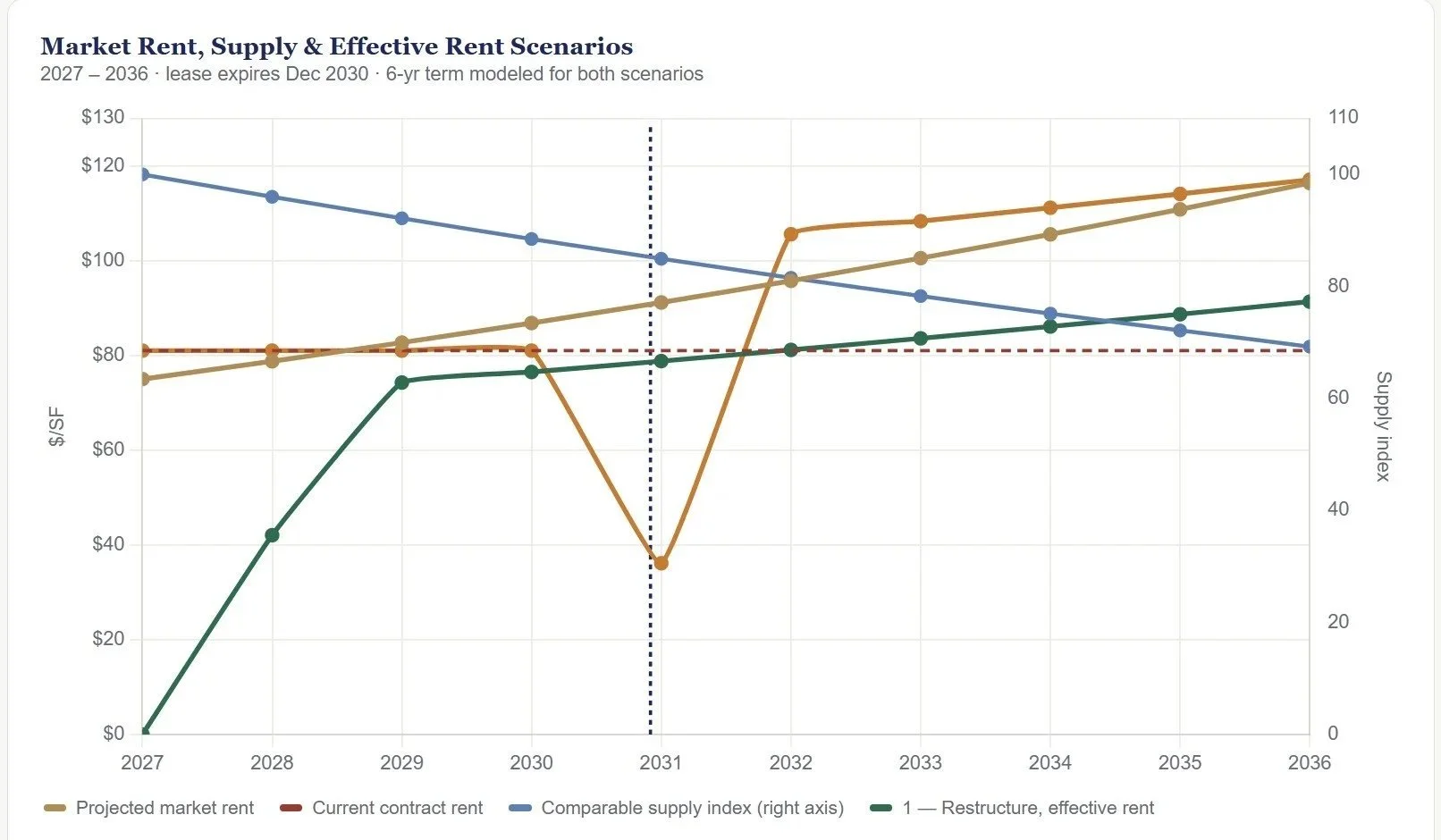
The gold line tracks projected market rent, the dashed red line holds today's contract rate flat, and the blue line (right axis) tracks comparable supply. The green line shows the blended effective rent of restructuring now, phased in against the free rent and TI package negotiated for the deal.
Importantly, sensitivity to market scenarios is also layered in. For example, what’s the likely performance of the rental market for comparable space over the subject period? Will rents rise or fall? Will supply increase or decrease?
Do Our Economic Policies Suck?
Economic policies are designed to enhance access to wealth and power. They're often purported to be discovered by a brilliant economist using math to prove a theory. And once such a theory is "proven", it's treated more as science than what it really is, a made up version of the world by an individual or individuals having their own bias – an answer in search of a question. This is what I've learned reading The Rebel Accountant's new book, Money Mania.
I'll admit it: I'm a skeptic. My personal default is to assume the game is rigged. Most of my career has been about ignoring the big questions (they are a distraction) so I can remain focused on the prize, maximizing my own results within whatever system I'm handed. I've not been ruthless but I've also not been especially contemplative. Money Mania forced me to consider some of the more prominent economic theories of the past century. It's hard to come away feeling like they didn't suck. Take Milton Friedman's 1970 argument that a company's only job is to grow shareholder profit. That idea pushed executives toward short-term wins over long-term strategy, and the result was often worse products, disengaged employees, and unhappy customers. A failed approach that did the opposite of what it was designed to do (e.g., it decreased shareholder value).
Here's the thing, economic rules aren't discovered, they're made up. Usually by the people who already have the most fortune and power. However they may be packaged, whatever massive benefit they proclaim to offer society, they were created to benefit a select few.
I've thought about my own career in Darwinian terms. It's always been me against everyone else. In my distorted version of my own economy, when things go well, it's because I've optimized my situation better than most. When things go badly, I've hit the limits of my resources. But I've rarely paused to consider the game itself.
Now we're at a moment of real consequence. A handful of world powers, individuals, and corporations hold the keys to AI, and AI will reshape everything. It may be the most economic power ever held by so few.
I'm a capitalist at heart. I want to believe in free markets. But Money Mania forced me to sit with how unevenly those markets spread their benefits, and to wonder if "free" mostly means free from government intervention, free from rules that would otherwise ensure broader distribution of benefit. All this so that a relatively small group can enjoy massive wealth and power.
Here's my takeaway: it's not enough to keep my head down and optimize for my own family. I must do better, to be mindful of the bigger picture. No, I won't be able to influence economic policy. But I can influence the small world of my economy. I can treat others better and strive to create opportunities for others in all that I do. Maybe that's how we make economic policy suck less.
The Unreasonable Landlord
As a tenant advisor, one of the hardest parts of my job is explaining to a client why a landlord won't accept terms that are otherwise reasonable and reflective of the market for comparable space, especially in a lease extension. The answer is tough to communicate, conveying as it does an element of responsibility to the client. You see, it's a matter of leverage, which is a function of time. When a tenant looking to extend an existing lease starts the process too late and fails to activate market leverage, the landlord can hold the line on above-market terms.
What occupiers sometimes miss is that while there's a comparable market where similar spaces, leased in a similar timeframe, tend to land at similar value, every transaction is still its own negotiation. The landlord is under no obligation to price its space "at market". In fact, their incentive is to maximize the value they extract from each lease. There's no ceiling or floor on that. The market is simply what a willing tenant will pay. And the "comparable market" is really just an average of outcomes, some negotiated well by tenants who used time and leverage, and some negotiated poorly by tenants who didn't.
The real difference isn't a comparison between reasonable and unreasonable, but what you get when you run a strategic process versus what you get when you show up late with no leverage. If I'm doing my job well, my client never has to ask why the landlord won't be reasonable. But the setup isn't always clean. I'm not always brought in early enough to build leverage before it's needed.
The fix is simple: start early and hire someone whose job is to build that leverage before you need it. Do that, and you'll find your landlord to be much more reasonable.
Thoughts on Agency
Regardless of the work, those with agency are the ones who thrive. It's what carries the mailroom clerk to the executive floor. It's what lets someone tune out the noise and just keep moving forward. It's the moment someone realizes the place they work is broken, and leaves to build something better themselves. It's where entrepreneurs live. When we have agency, we see ourselves as capable of more, capable of being better.
In truth, the best companies foster agency in their employees. They want people who think for themselves, who push boundaries, who color outside the lines. That's where the magic happens. It doesn't matter if you manufacture widgets or build AI: most of the advancements in your product will come from the relatively small percentage of employees who think for themselves.
There's no question we're in a time of great change. We're moving fast from changes in where we work to far more significant changes in how we work, driven by continued advances in AI. This is not a time to play the victim. It's a time to look for ways to be part of the future, not a time to get stuck in "this is how we've always done it." This moment calls for flexibility, for curiosity about what's next. In the end, agency brings accountability. Those who have it feel a measure of control over their work, and their lives, that is, ultimately, healthy.
The Advisor's Dilemma
Often, the quality of a company's real estate planning is limited more by internal dynamics than external market factors. Corporations are, after all, a collection of people, each with their own interpretations and behaviors. Soon after its first communication, a leader's vision risks getting lost in translation. And not all leaders have a clear vision to begin with. They got where they are by trusting their own instincts, by believing their ideas are better. This can make them less open to being challenged, breathing life into bad ideas.
Real estate planning can feel like a less dramatic version of the movie Speed, in which Keanu Reeves and Sandra Bullock create and execute real-time strategy amid the chaos of keeping a bus above 50 MPH to avoid a bomb that will kill everyone aboard. No one's likely to die from a bad office. But your company might.
As an advisor, I sometimes see flaws in the mission itself, usually the result of leadership failing to consider all factors before setting objectives. For example: leadership wants a near-term sale of the company, valued as a multiple of EBITDA, then executes a lease that hurts EBITDA.
More common than a flawed mission is a lack of capability to execute it, which usually shows up in a very human way. The team tasked with the project is inexperienced and insecure. With the right advisor, inexperience isn't a problem, it's an opportunity. A good advisor-client partnership builds internal teams. Insecurity is the real killer. An insecure team hides its lack of knowledge out of fear of losing its job. That breaks the communication between advisor and client, and the outcome suffers.
The advisor's dilemma is how to address this. Advisors rarely have access to the top, where the flawed mission began, and even less often the credibility to question it there. At the execution level, the dilemma looks different: whether to flag internal team dynamics that threaten the outcome, and if so, to whom.
The advisor's own incentives complicate things further. Paid on completed transactions, it's easy to look the other way. Take the order, do the deal. Yes, the plan is flawed, but you're not paid to fight that fight, you're paid to transact. The strong advisor finds a way anyway: making sure leadership has considered every alternative, helping bridge gaps in capability, and putting the right solution ahead of just getting deals done.
Coming Soon!
At TenantSee, we're building tools to cut the risk and friction out of leasing office space — starting with Create Office, our proprietary algorithm that combines strategic market inputs with Cushman & Wakefield data to help you define the right target before you ever engage the market.
Answer a few questions and Create Office approximates the space you need, the capital required, and the annualized cost, giving you a clear read on where to focus your search. It connects the dots between space usage, building type, design, location, and lease term, so you can see the financial impact of each decision before you make it.
The result: align people, finance, design, and real estate around one optimal outcome, then go to market with a laser focus instead of noise. Less wasted time. Better economics. A stronger employee experience.
Create Office launches soon. Stay tuned.
Consulting vs. Brokering
The lease expires in 24 months. You've been in the space five years. Everyone likes it. The working assumption is you'll extend when the time comes. Nothing to think about just yet.
Or is there?
One of the persistent challenges in my business is breaking through institutionalized and misinformed assumptions about the office lease. Markets have trained companies to treat the lease as fixed: something you address when the term ends, or when some external force demands it, an expansion, a contraction, or a crisis. Broker relationships tend to be structured the same way. Communication picks up near expiration, when it's time to transact. You can forgive leaders for writing off the entire brokerage business as transactional, given the volume of emails and calls that materialize the moment a lease date appears on someone's radar.
The problem is what you're not seeing in the meantime.
During the final 36 months of a lease, three things deserve ongoing attention: how the space is actually serving the company, what the market is doing, and what's happening inside the building. This is the window where opportunities are routinely missed, not through negligence, but through a lack of structured awareness.
The use case question is fundamental. Is the space still working? Has headcount, work model, or collaboration behavior shifted enough to warrant a different footprint? If the bias is to stay, what changes would make staying the right answer?
The market question is equally important, and often counterintuitive. In-place economics that look favorable today can look very different in 24 months if rents are trending upward. When the intent is to renew, moving early to lock in current market terms can be a meaningful financial decision, avoiding as it does the cost of a spiking market.
And the building dynamic matters in ways that aren't always visible from the outside. A landlord managing a vacancy problem or a maturing loan has a different calculus than one operating from a position of strength. A tenant willing to extend early, adding weighted average lease term to the rent roll, may find the landlord unusually motivated to structure a deal that reflects that value. These moments don't announce themselves. They require someone who is paying attention.
The discipline to operate this way is not the norm. It is fundamentally at odds with a business model built around transaction volume. Brokers whose business centers on transacting have limited incentive to initiate conversations that may conclude with "not yet" or "nothing to do here." But there is a subset of tenant advisors who work differently. Consultative by nature, they stay in the conversation between transactions. Their clients don't think of them as brokers in the transactional sense. They think of them as advisors who happen to execute leases when the moment is right.
This is the layer of advisory where strategic opportunity lives. It’s the difference between consulting and brokering.
Marketing Hype vs. Reality
Those who sell real estate services have rarely let the truth get in the way of a good story. Even before the promise of AI, it wasn't difficult to find marketing narratives that tested the boundaries of truth. Now, as the entire world braces for significant changes in how stuff gets done, the real estate industry is, once again, drawing the attention of those with designs on upending a business that has functioned the same way for decades.
From our vantage point, we welcome change. We've embraced powerful AI resources, like Claude, to streamline workflows and build and improve tools that previously may have required 3rd party software and/or were difficult to stand up. But for now, the markets are not agentic. Those looking to secure longer-term office solutions must still navigate a complex labyrinth of variables. Only a highly experienced and skilled tenant advisor can provide the strategy and resources necessary for optimal results. The best advisors draw on scaled resources like market research and deep market engagement, and they employ proprietary strategies to create market leverage.
For our part, we continue to lean heavily into the belief that the best office solutions reflect an upfront understanding of the nuanced interplay between key drivers, from budget to design to employee experience. You can't just wander into the market, start looking at buildings, and expect the best result.
Some new market entrants are selling the promise of better search, faster service, and avoidance of those pesky brokers that make everything unnecessarily complicated. These companies purport to offer one place to see all available space, making the process of leasing an office feel more like renting an Airbnb or searching for a home on Zillow. It's a tempting idea. The problem? There are many.
First, the premise of easy search is a fallacy. The limited supply one can find online reflects a small segment of total available supply and is often fraught with inaccurate information on availability, rental economics, and more. When you casually search for office space online, you are not seeing the full picture. The only way to conduct a thorough search is to first define your target objectives and then filter the entire available supply against those objectives.
Next, there is the problem of information. Startup and small real estate firms lack experience and depth in the markets. They're missing vital data. Their deficiencies run from lacking basic comps, to knowing which tenants are actively negotiating, to being unable to ascertain market trends, to failing to understand the capital market dynamics that shape how investors negotiate. Offers submitted by these advisors are typically weak and poorly crafted.
These advisors aren't really advisors at all. They're more like the concierge desk at your favorite hotel. They may describe their service as "free to you, the tenant." This disingenuous misrepresentation has been made by weak service providers for decades. The tenant broker fee is the same regardless of whether you use a highly qualified advisor or a fast-talking concierge. The "don't worry, we're free" narrative exists to distract you from asking what services you're actually getting for the fee.
To be fair, companies seeking office space are at least partially to blame for the emergence of these service-light models. Startup companies want an office market that functions like Airbnb. They want "AirOffice." For seed or Series A startups, this is understandable. They obtain funding and the first thing they want to do is hire and bring people together. But the markets are increasingly littered with bad real estate decisions.
It pays to do a little research before securing office space: understand how the process works and the role brokers play before jumping straight to identifying space options. The complexity of the market has not changed. Good outcomes are about more than pretty pictures. The information you need to make great decisions remains largely opaque, known only by those who are now and have long been deeply engaged in the markets. Be wary of the chasm between marketing hype and market reality - - - it’s where your lease shifts from asset to liability.
Starting at What, Not Where
Deciding where to lease office space can be unexpectedly challenging. Every decision variable eventually translates into economic value, either as a cost or a benefit. But the real challenge is what we call the search problem: companies often begin with “where” when they should begin with “what.”
Starting with what means bringing the right stakeholders together before the search begins. It means building consensus around the factors that drive value and clarifying what the company needs its office to accomplish.
Markets present options. Those options are all different. An occupier that starts touring space without a clear vision of the desired outcome oftenends up chasing one imperfect solution after another. Each option is abandoned when the team discovers it fails to meet a need they had not fully considered. One common example is when the people leading the search are not closely aligned with the financial considerations that matter most to the executive team.
The quality of a lease solution ultimately reflects how well it addresses the full spectrum of variables that define value, with each variable weighted appropriately.
Before you think about where, spend time defining what.
Put the right team in place, including finance and human resources. Study location drivers like employee commute patterns. Discuss the budget, not only annual rent expense but also the capital required to transact. Evaluate the time needed to execute the project correctly. Consider how different space solutions and designs may affect employee engagement, recruiting, and brand.
Bring in a real estate advisor early. The best tenant advisors guide companies through a thoughtful process that produces a specific target outcome, matched to a realistic timeline.
A strong “what” should include the target market, the type of space, the type of building, the project timeline, and the project budget. It may also reveal that certain objectives need to be adjusted because they are not realistically actionable. That is something you want to learn before going to market, not after.
Once your what is fully defined and tested, you’re ready for where.
The "Gretzky Market"
Three forces have converged to create upward pressure on San Francisco office rents. Yes, you read that correctly: upward pressure.
First, solvent landlords with a reasonable cost basis and stable capital stack are ignoring the headline statistics. They know the market vacancy rate exceeds 30%. They don’t care. They don’t have to. Vacancy is heavily concentrated in distressed and lower-quality assets, while leasing activity remains focused on a much narrower segment of available supply. Conditions in one segment of the market do not necessarily dictate outcomes in another.
Second, sophisticated data analytics are changing how landlords price space. By segmenting demand and supply with far greater precision and providing real-time visibility into market activity, these tools allow landlords to make increasingly strategic pricing decisions. As discussed in last week's article on dynamic pricing, owners are no longer relying solely on historical lease comparables to establish value.
Third, and perhaps most important because it involves human behavior and compensation, we are hearing anecdotal reports that leasing and capital markets teams are entering a phase of the cycle where winning assignments increasingly depends on telling owners what they want to hear rather than applying conservative underwriting assumptions. Once this dynamic takes hold, it tends to reinforce itself as competitors begin marketing some version of "market-plus" pricing to secure new business.
When these three forces come together, landlord rent expectations can begin to detach from what can reasonably be viewed as current market value.
I call this a "Gretzky Market."
Wayne Gretzky famously said, "I skate to where the puck is going to be, not where it has been."
Today, landlords are beginning to ask occupiers to pay based on where they believe rents will be, not where they are now.
Dynamic Pricing Has Arrived in the Office Market
Landlords are increasingly using sophisticated, real-time data to determine how they price available office space. Historically, asking rents were established primarily through comparable lease transactions. The problem is that comparable lease data is inherently backward-looking. By the time a transaction becomes part of the market narrative, the economics were often negotiated months earlier. It was also difficult to precisely isolate the true competitive set for a particular space and understand the real-time dynamics within that subset of supply.
That is changing.
Today, institutional landlords can access highly detailed leasing intelligence through platforms like VTS, a software system widely used to track leasing activity across institutional office portfolios. Landlords require their leasing teams and brokers to report market activity into the platform, creating an expansive real-time dataset. Most major institutional owners now operate within this ecosystem.
More importantly, AI is beginning to transform that raw activity into strategic insight.
Landlords can now dissect the market at a micro level, segmenting supply by building quality, floor size, geography, tenant profile, availability timing, and competitive positioning. Instead of relying solely on completed lease transactions, they can analyze active negotiations and letter-of-intent pricing to understand where the market is moving in real time. In many cases, this provides a more accurate picture of current pricing pressure than signed leases.
The implications are significant.
We are beginning to see landlords make strategic pricing decisions based not simply on where the market was six months ago, but on where they believe it is heading. In some cases, owners may intentionally hold space off the market, allowing competing inventory to lease first so their remaining availability enters a tighter supply environment. Scarcity drives leverage, and leverage drives pricing.
This introduces a new level of complexity for occupiers.
Companies and their advisors must now understand the mechanics of dynamic pricing and the data influencing landlord behavior. Tenant advisors must possess the strategic capability to interpret the data and get ahead of how the landlord is using it to gain leverage in the negotiations.
Our long-held belief in “selling our client’s tenancy,” as opposed to simply helping them “lease space”, has never been more relevant. Data may support a landlord’s pricing thesis, but not all demand carries equal value. The tenant willing to pay the highest rent is not always the tenant a landlord most wants over the long-term.